
Mito-jo (Mito city, Ibaraki)|An Ōtemon Gate, a Yakuimon Gate, and large moats—there are so many highlights to see! From the residence of the Sengoku daimyo, the Satake clan, to the Tokugawa family
- 1. Castle lovers are sure to feel excited!
- 2. From inside the Ōtemon Gate, I proceeded further into the Ninomaru!
- 3. The Yakuimon Gate and the Honmaru ruins are located within Mito First High School!
- 4. At last, on to the Ninomaru Corner Turret (Sumiyagura)!!
- 5. Now, on to the large dry moat of the Sannomaru!
Castle lovers are sure to feel excited!
Hello, this is Shin.
May 6, 2023 (Saturday).
This was my second castle visit of the day. 🚙
Earlier, I visited the ruins of Ōda-jo (Maizuru Castle), the residence of the Sengoku daimyo of Hitachi, the Satake clan,
 https://sengokucastle.com/hitachiooda-jo/
I have now arrived at Mito-jō (Hitachi Province), where the Satake clan later moved their residence ✨

◉ Castle Type
Hilltop castle (okajiro)
◉ Cultural Heritage Highlights
◉ Defensive Features & Fortifications
◉ Exploration Difficulty
🟡 Moderate Castles
◉ Estimated Time to walk around
: about 2 hours
◉ Parking
About 20 spaces at the Kōdōkan parking lot, and many additional parking spaces at the Sannomaru government office
About a 10-minute walk from JR Mito Station🚃
If you’re going by car, it’s smoother to search for “Mito Domain Kōdōkan Parking” rather than “Mito Castle Ruins.”
It’s quite common to arrive by car and end up wasting time because you can’t find the parking area 😅
Also, since it’s about a 10-minute walk from JR Mito Station, access by train is convenient as well.
Taking the train would be a good option.
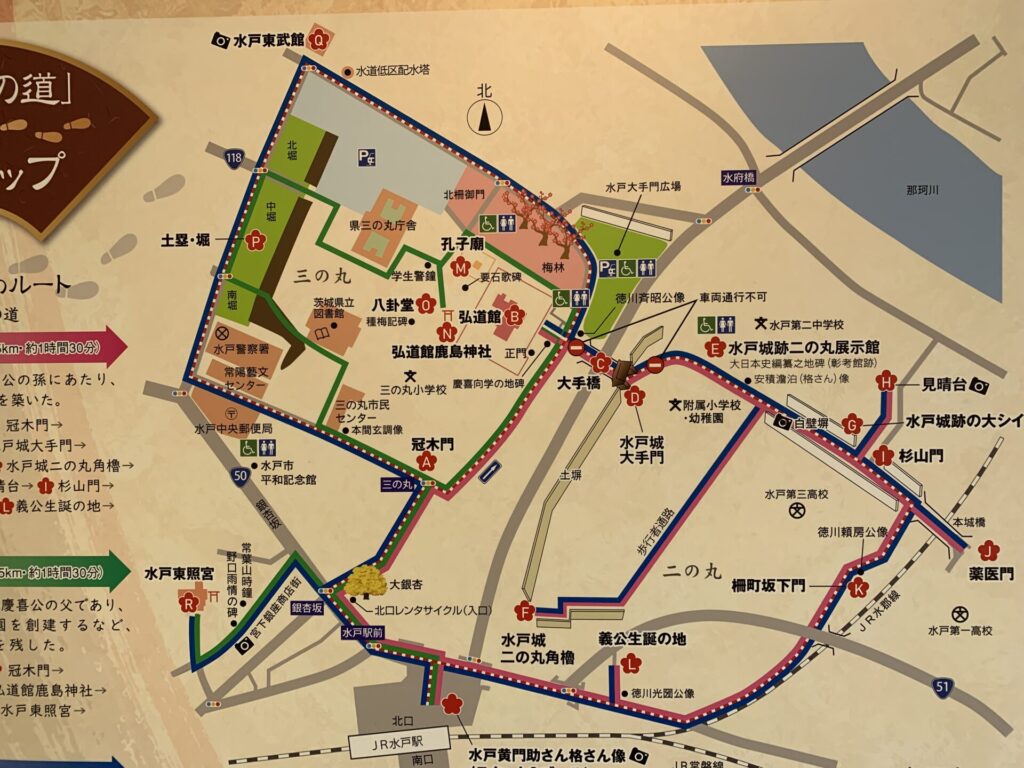
After safely parking in front of the Kōdōkan, I immediately checked the castle layout using the surrounding map as a guide.
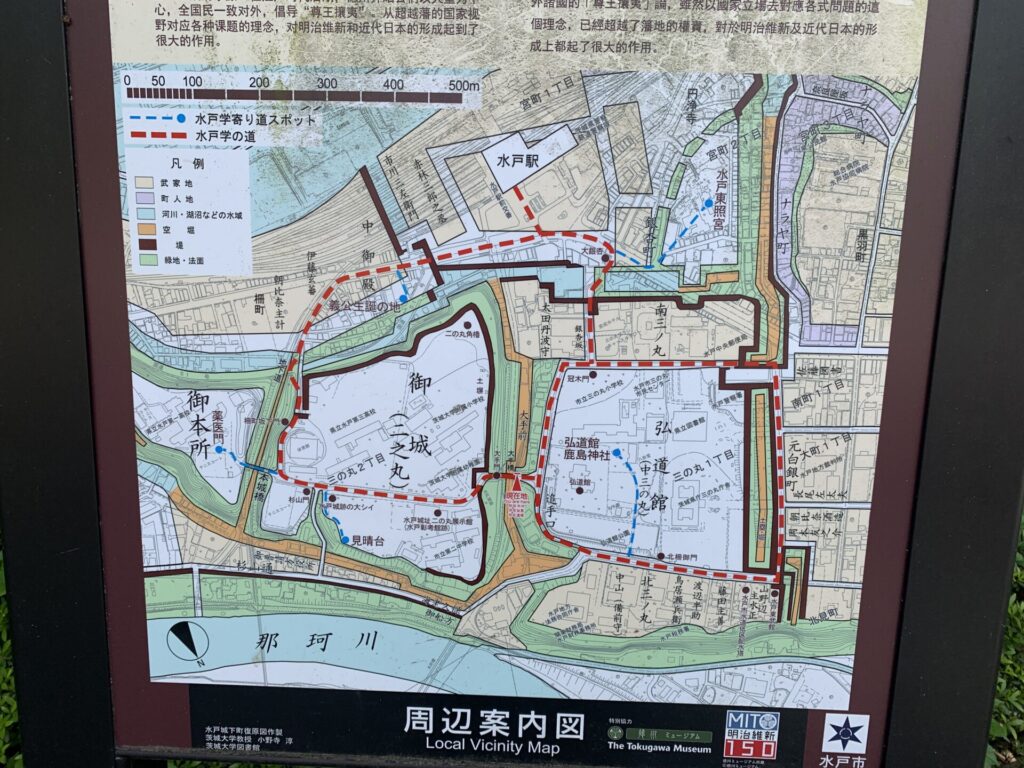
Speaking of Mito-jo, it is known as the residence of the Mito Domain, one of the Tokugawa Family,
and even today, various cultural remains still exist, making it an enjoyable site for history enthusiasts.
However, I am focusing more on the Sengoku period—specifically on the fact that the Sengoku daimyo, the Satake clan, once used it as their residence,
as well as on the castle layout itself, so please bear with me 🙇
For that reason, I did not stop by the Kōdōkan, which history lovers would almost certainly visit 💦
I am focusing entirely on the castle as a defensive structure.
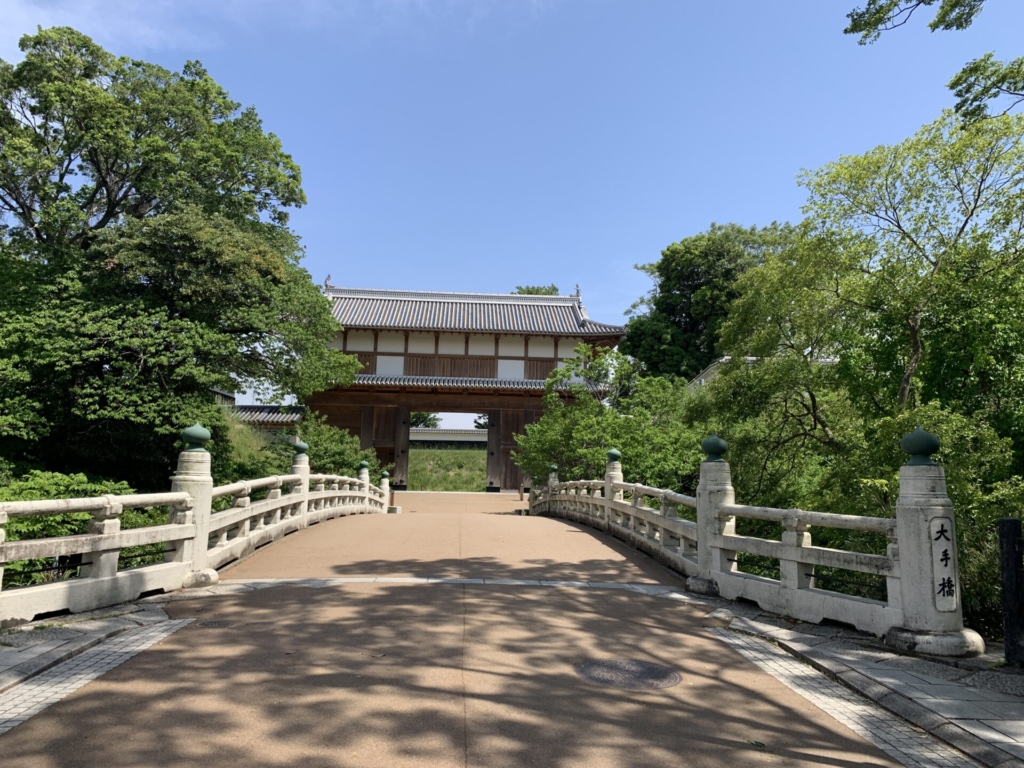
Even before parking the car, signs reading “Sannomaru Government Office” and large dry moats were already coming into view,
and that alone had me excited.
But first, I was truly impressed by the large Ōtemon Gate (大手門) in front of the Kōdōkan! ✨
It’s definitely a great photo spot. 😀
I had assumed that Mito-jo was a flatland castle (丘城:okajiro),
but after taking a closer look around later, I realized it is actually a hilltop castle (okajiro) built on elevated ground.
Now, please take a look at the Ōtemon Gate (大手門) in this video.
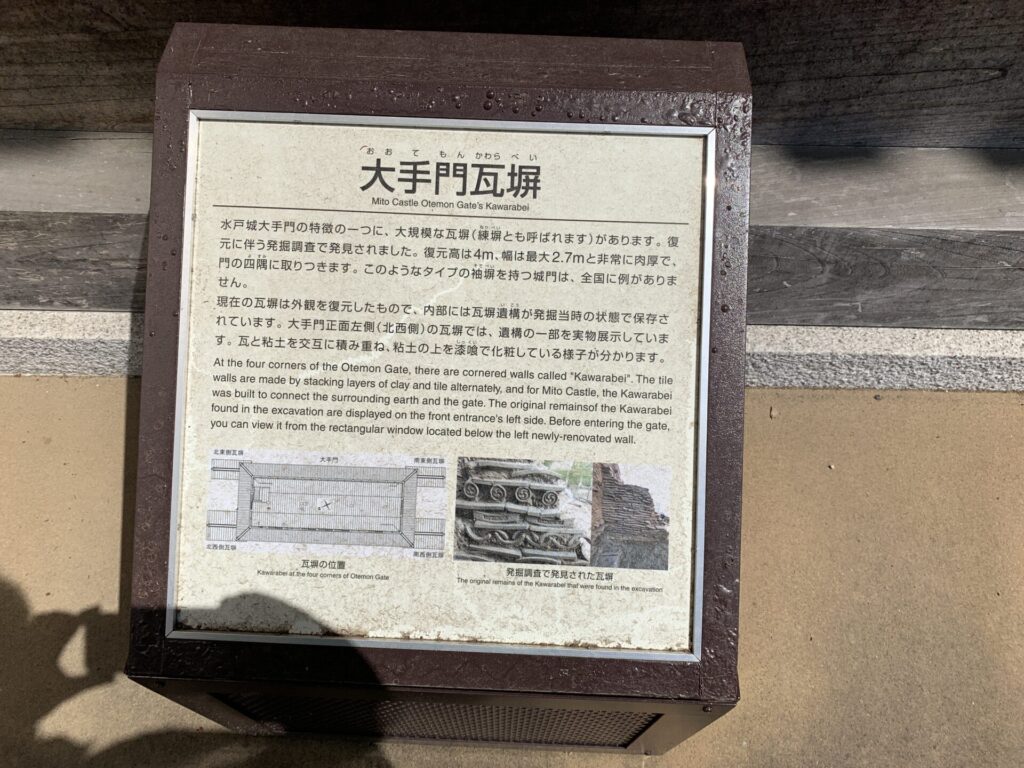
The tiled wall of the Ōtemon Gate (大手門) appears to be quite rare on a national level.
Next, I filmed a video from inside the Ōtemon Gate (大手門) , capturing the surrounding area.
From inside the Ōtemon Gate, I proceeded further into the Ninomaru!
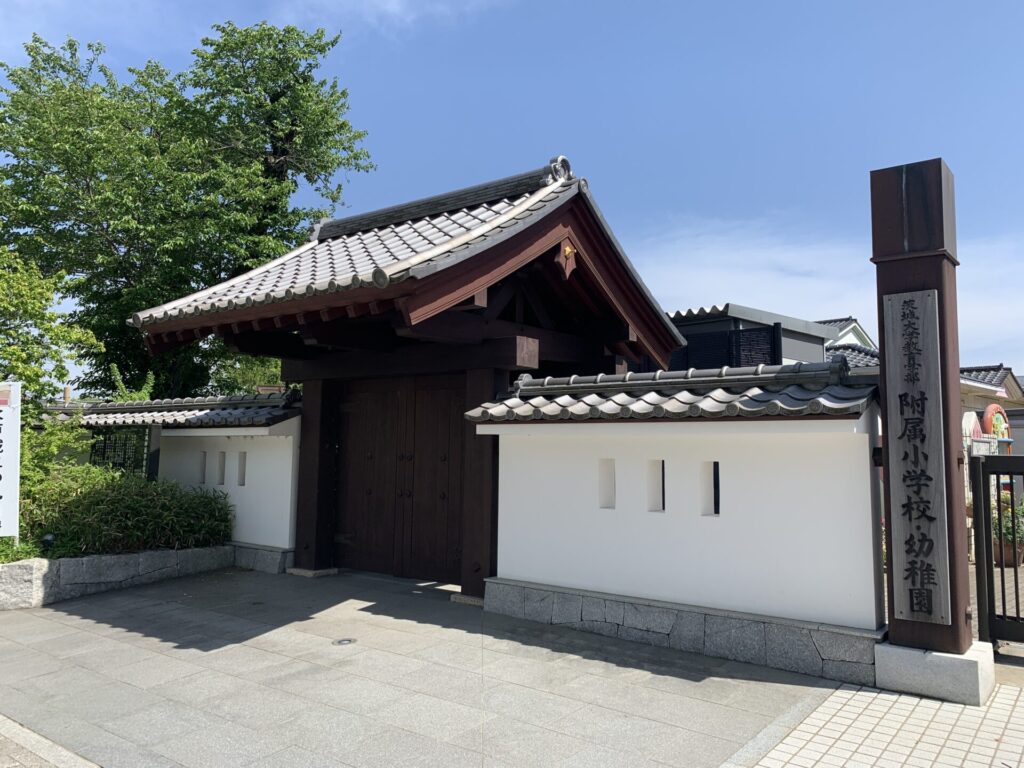
After passing through the Ōtemon Gate, you will immediately see an elementary school and kindergarten on your right.
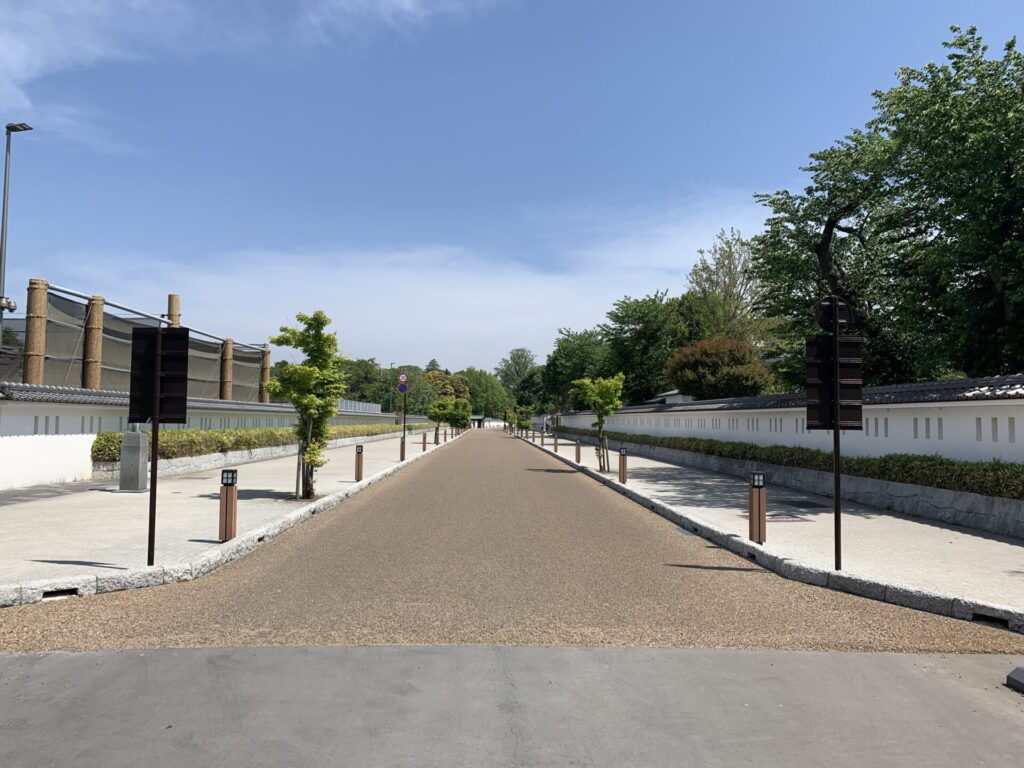
There is an elementary school on the right, and a junior high school on the left.
Castle ruins often end up being used as school grounds or similar facilities.
Even so, isn’t this long stretch of wall magnificent? 😳✨
From here, I move on toward the Sugiyama Gate, the Yakuimon Gate, and the Ninomaru Corner Turret !! ✊
Please watch the video to see how I continue advancing further.
By the way, the building shown at the end of the video was the “Mito Castle Ruins Ninomaru Exhibition Hall”.
The interior wasn’t particularly large, but if you’re interested, it might be worth taking a look.
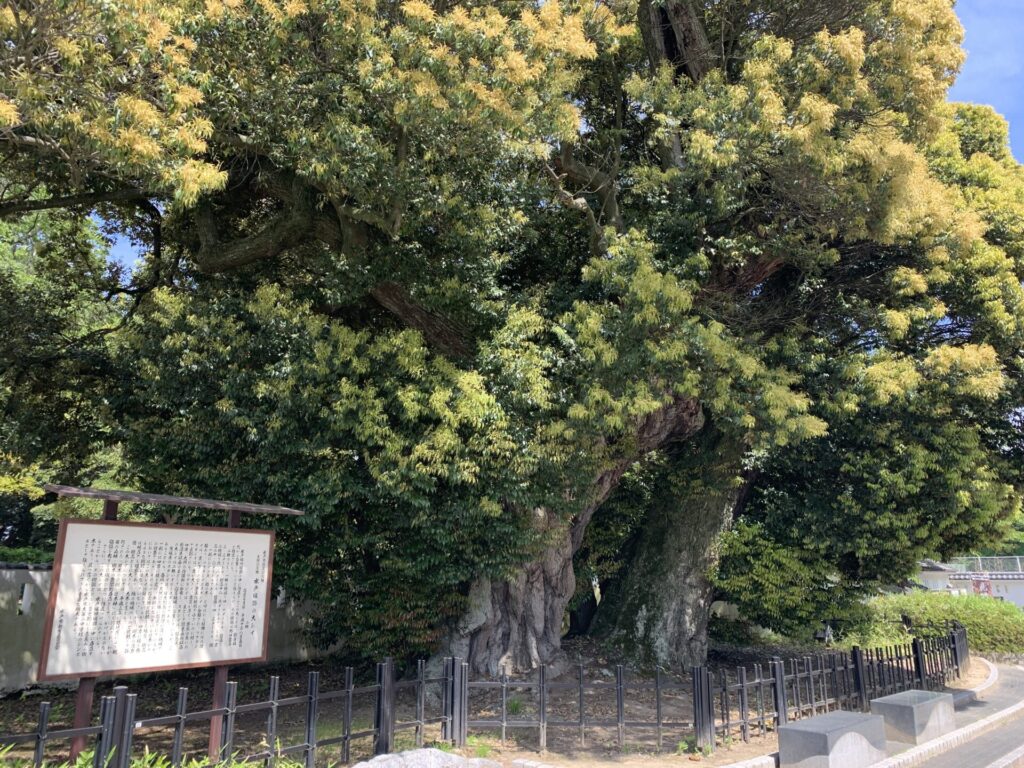
Along the way, there was also a large chinquapin tree like this.
From the appearance of its trunk, you can truly feel the long history it has witnessed.
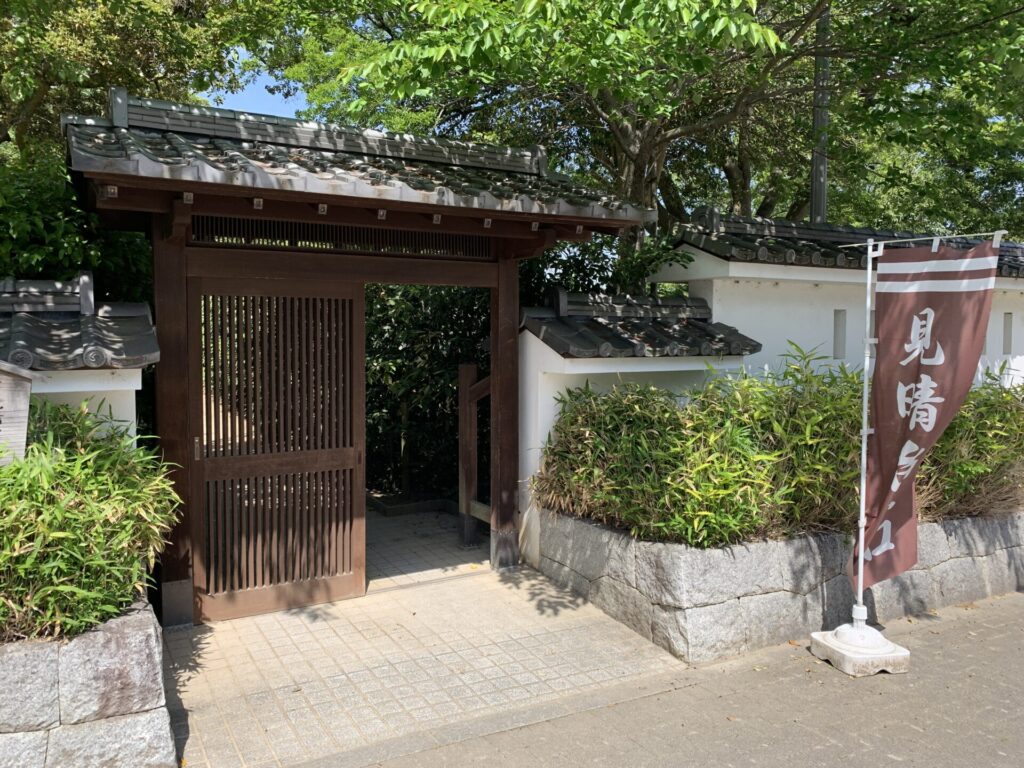
And right beside that chinquapin tree, there was a place called an “Miharashidai (見晴らし台:Observation Deck)” like this.
It seemed like the perfect spot to truly realize that Mito-jo is a hilltop castle (okajiro)!
With that in mind, I stepped inside.
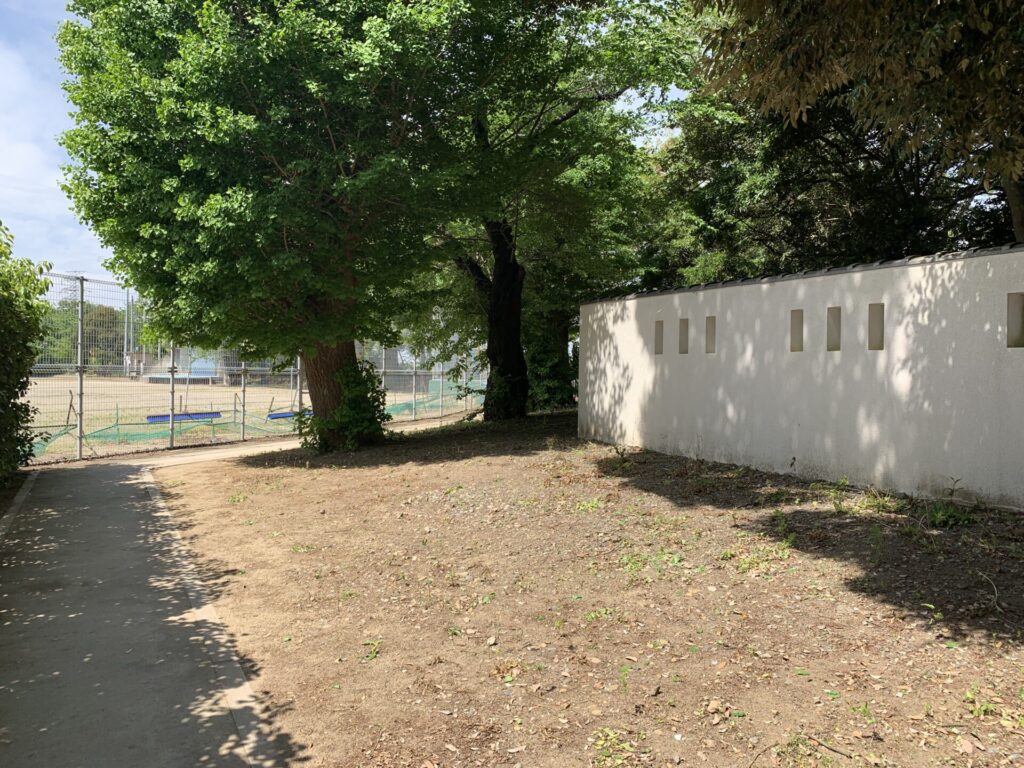
I continued along a path that stretches on for quite a distance.
In the distance to the left, you can see the junior high school.
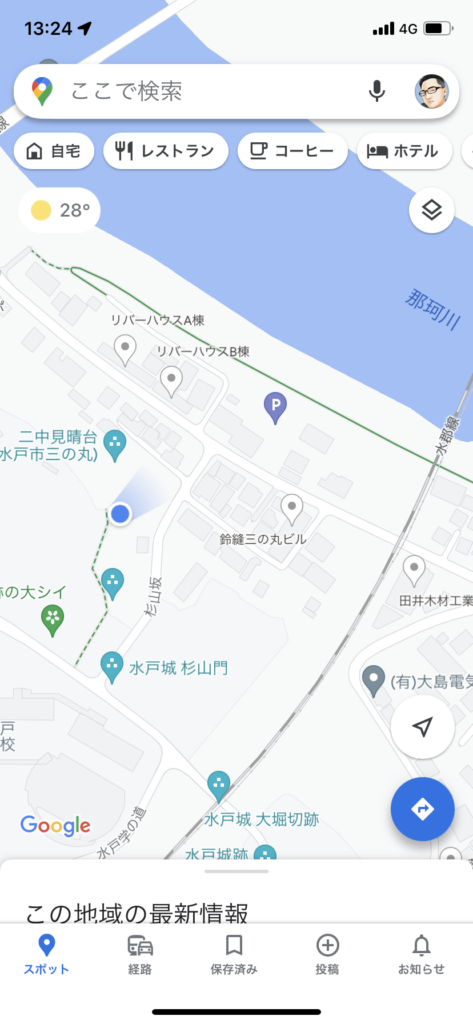
When checking on Google Maps,
the relative positions look just like this.
Ahead of us, the large Naka River (那珂川) comes into view.
Here is a video of the view of the Naka River from this observation deck.
You can see that it is indeed a hilltop castle (okajiro) with a certain degree of elevation.
The breeze was pleasant, and it was a spot with a wonderful view.
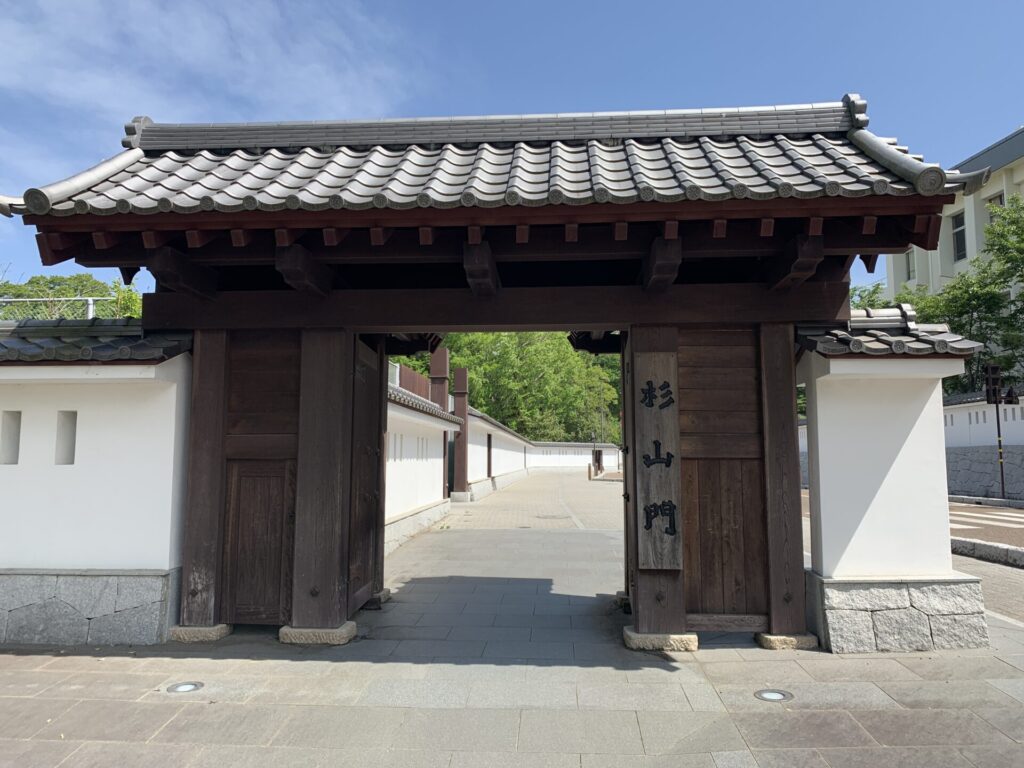
Next to come into view was this “Sugiyamamon Gate (杉山門)”.
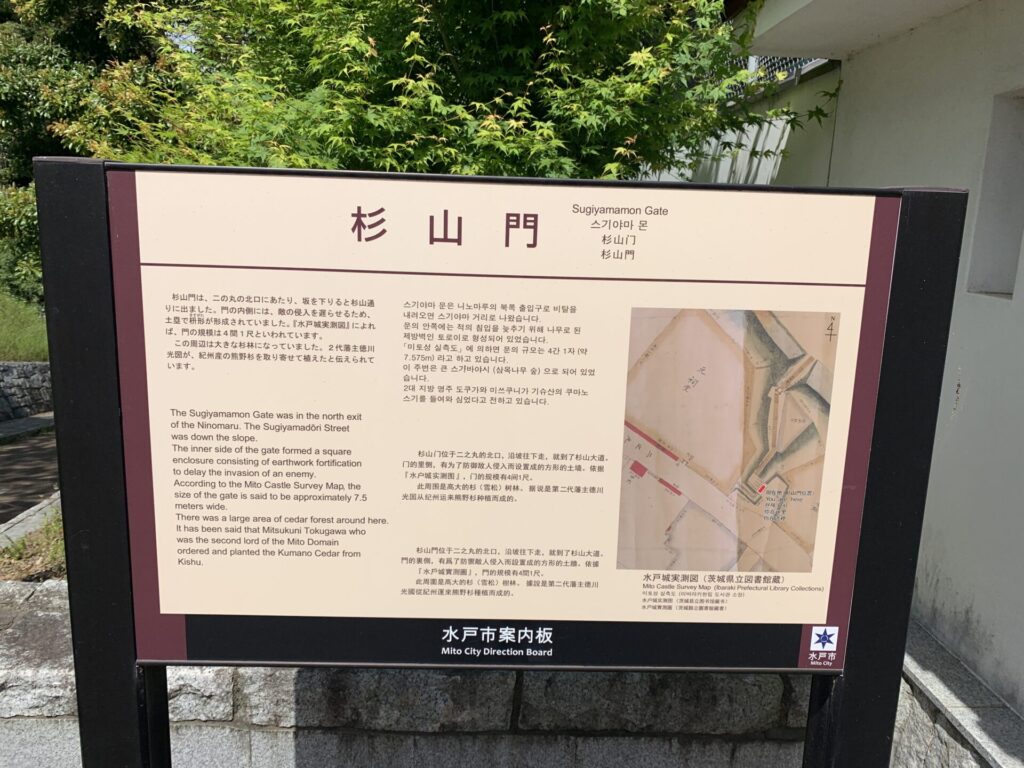
As explained on this information board,
there is a slope just in front of the “Sugiyamamon Gate (杉山門)”,
and its winding shape helped slow down invading enemies.
It is what is known as a “Masugata Koguchi” (枡形虎口: box-shaped defensive entrance) reinforced by earthen ramparts!
If you’re wondering, “What is a masugata koguchi?” please refer to the article below.
Now, please take a look at the approach just in front of the Sugiyamamon Gate in this video.
The Yakuimon Gate and the Honmaru ruins are located within Mito First High School!
After passing through the Sugiyamamon Gate, I proceed further inward toward the Yakuimon Gate (薬医門).
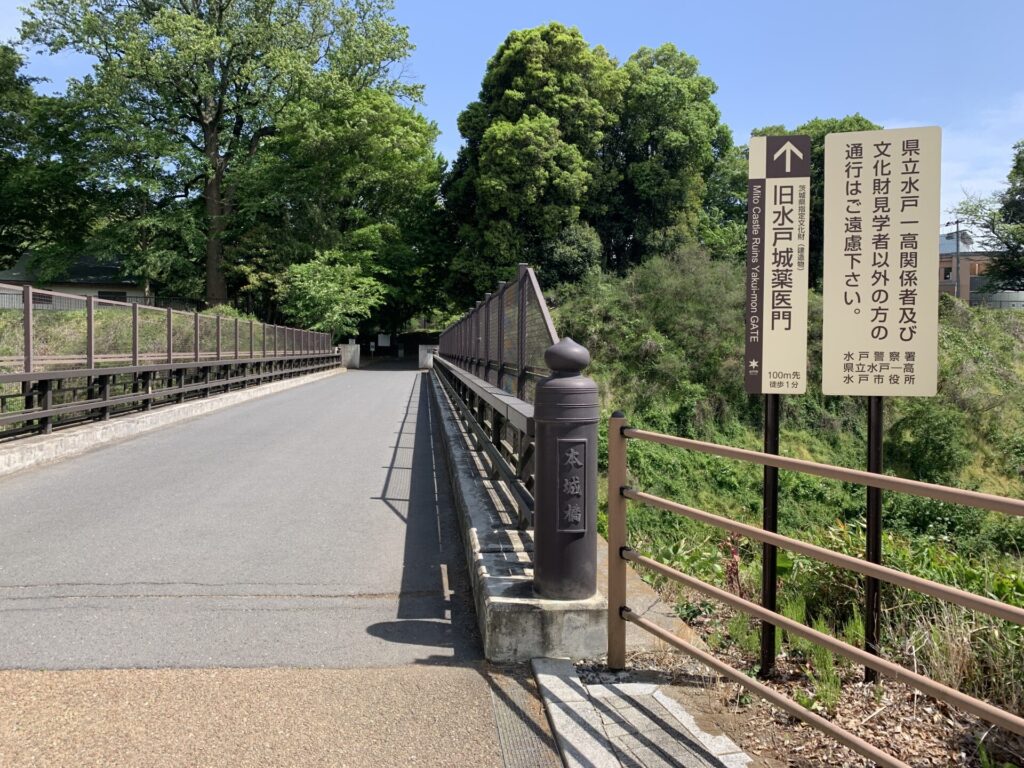
Beyond this bridge stands the Yakuimon Gate(薬医門).
It appears that the Yakuimon Gate is located within the grounds of Ibaraki Prefectural Mito First High School.
Beneath this bridge run the tracks of the JR Mito Line, and you can tell that this area was once a large moat.
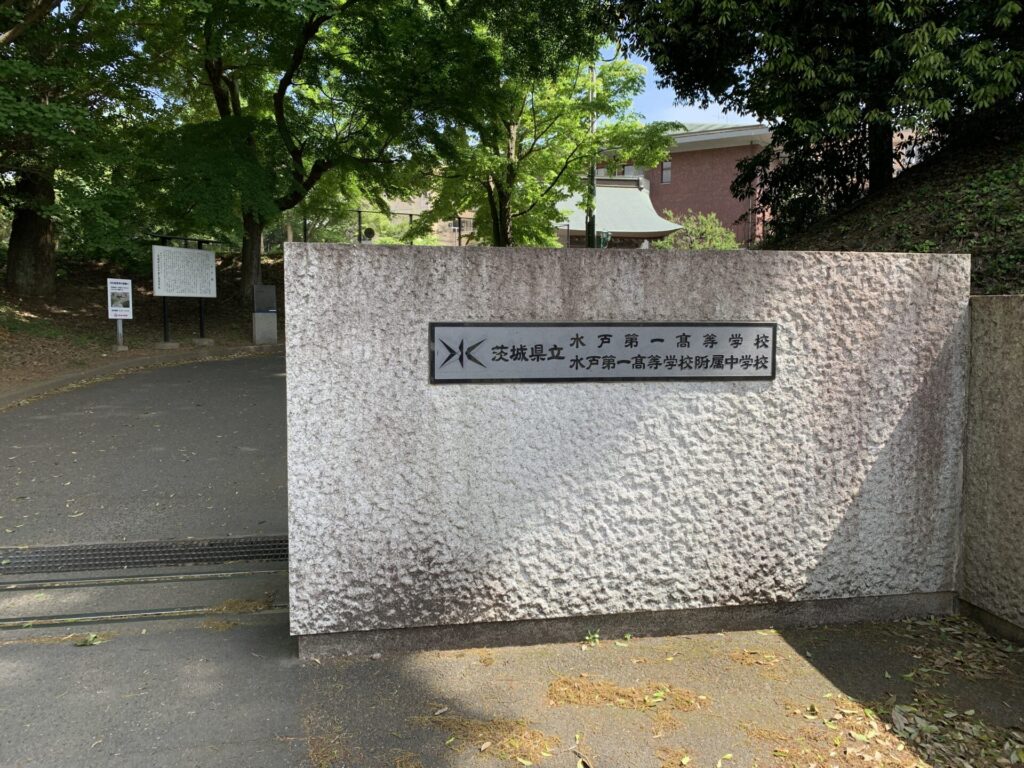
This is in front of the main gate of Mito First High School.
You can faintly see the Yakuimon Gate in the distance.
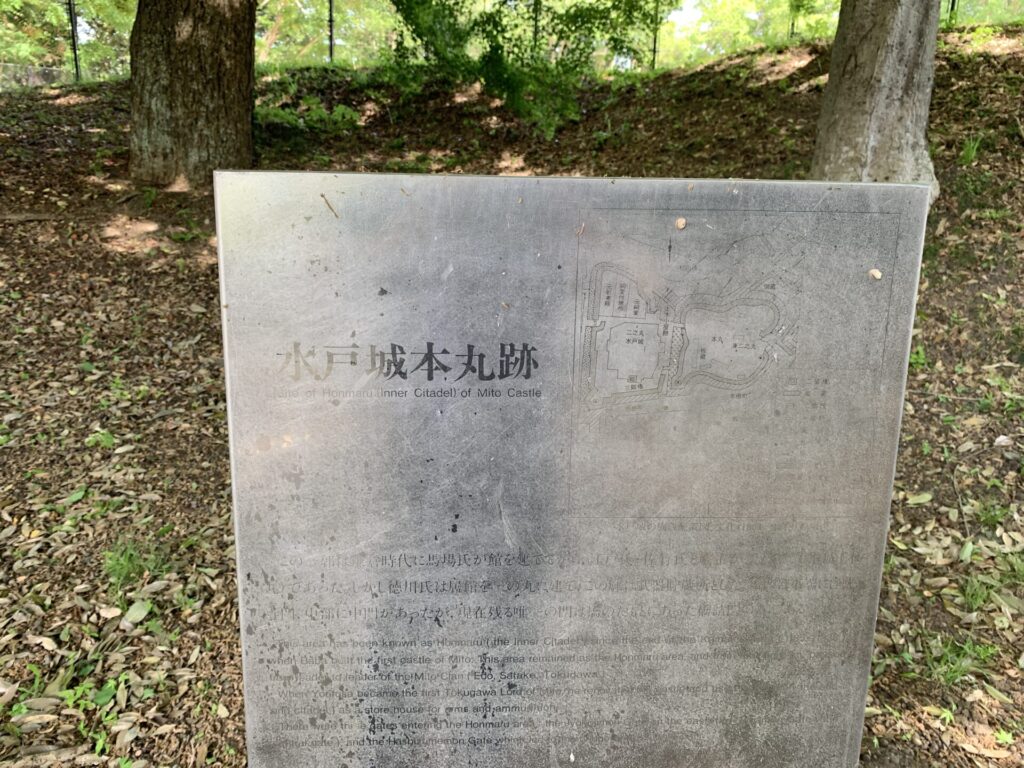
The lettering has faded and is barely readable,
but at last, I have arrived at the site of Mito-jo’s Honmaru(本丸: Main Enclosure).
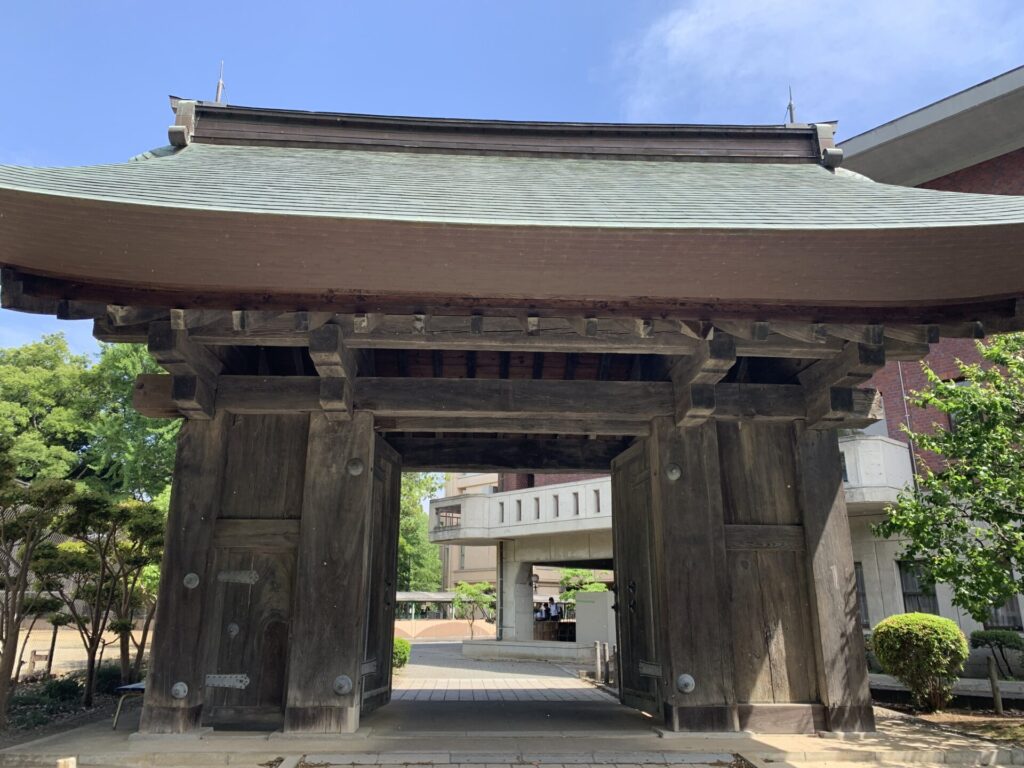
This is the Yakuimon Gate(薬医門).
You can really feel its age.
According to the information board beside it,
it appears to be the only surviving structure of Mito-jo, and its estimated construction dates back to the Azuchi–Momoyama period ( 1573-1603 )… 😱
I filmed a video so you can fully appreciate the age of this gate—please take a look.
What do you think of the age of these pillars?
You can truly feel the weight of history.
When you realize this may be a remnant from the Sengoku period, it becomes all the more moving…
At last, on to the Ninomaru Corner Turret (Sumiyagura)!!
After fully appreciating the history of the Yakuimon Gate, I left Mito First High School.
Thank you very much!! 🙇
Next, I crossed back over the bridge and headed toward Sakumachi Sakashita Gate (柵町坂下門), located at the lower right of the map.
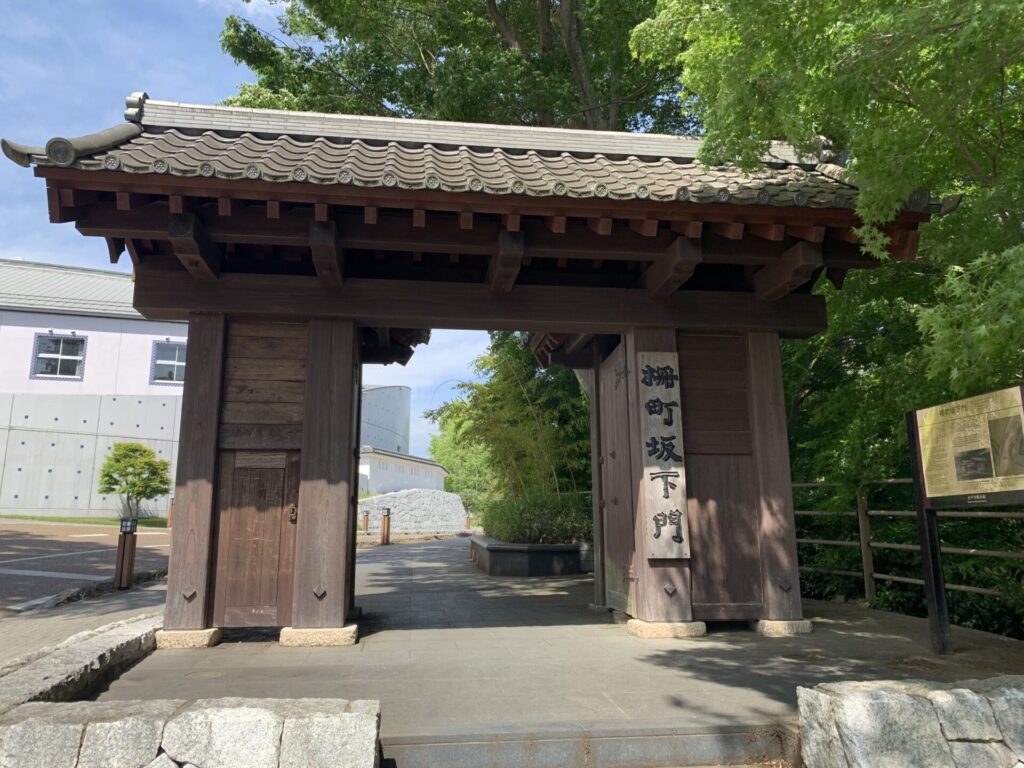
This is the Sakumachi Sakashita Gate (柵町坂下門).
You can truly feel a sense of history—of atmosphere—about this gate as well.
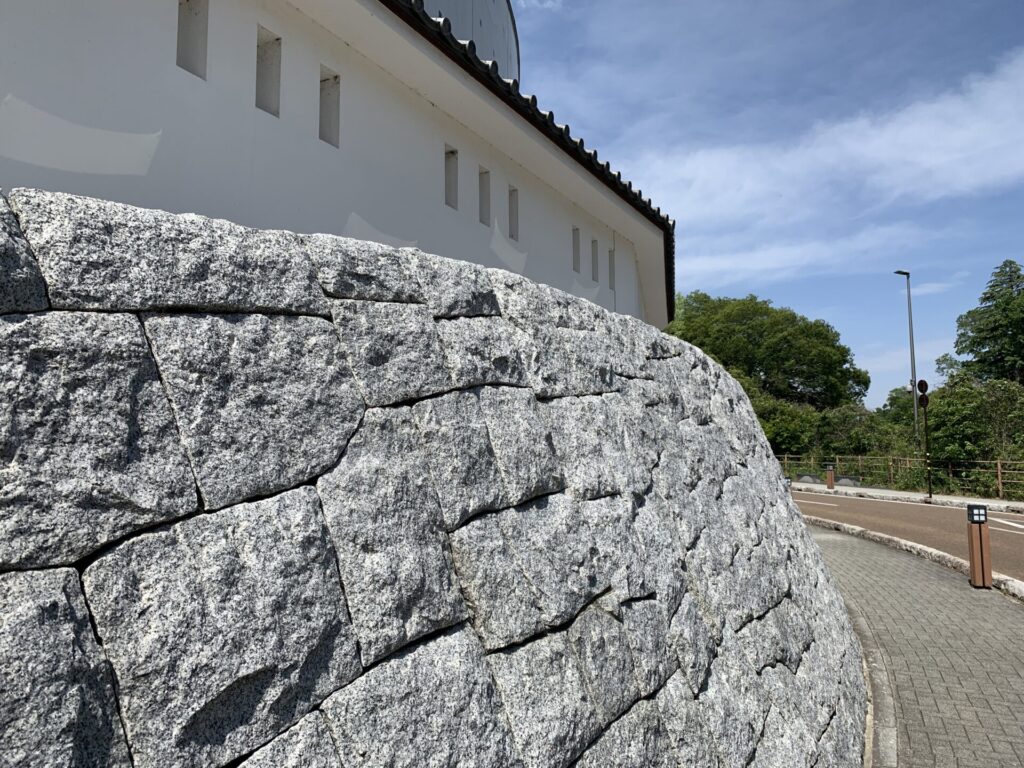
At this point, I turned back along the path I had come.
Next, it’s finally time to head to the Ninomaru Sumiyagura(二の丸角櫓:Ninomaru Corner Turret ) of Mito-jo!
As I retraced my steps, a stone wall and fence suddenly caught my eye.
It is the wall surrounding Mito Third High School.
Although it is not something that has remained from that time,
isn’t this kind of scenery irresistible for castle enthusiasts?
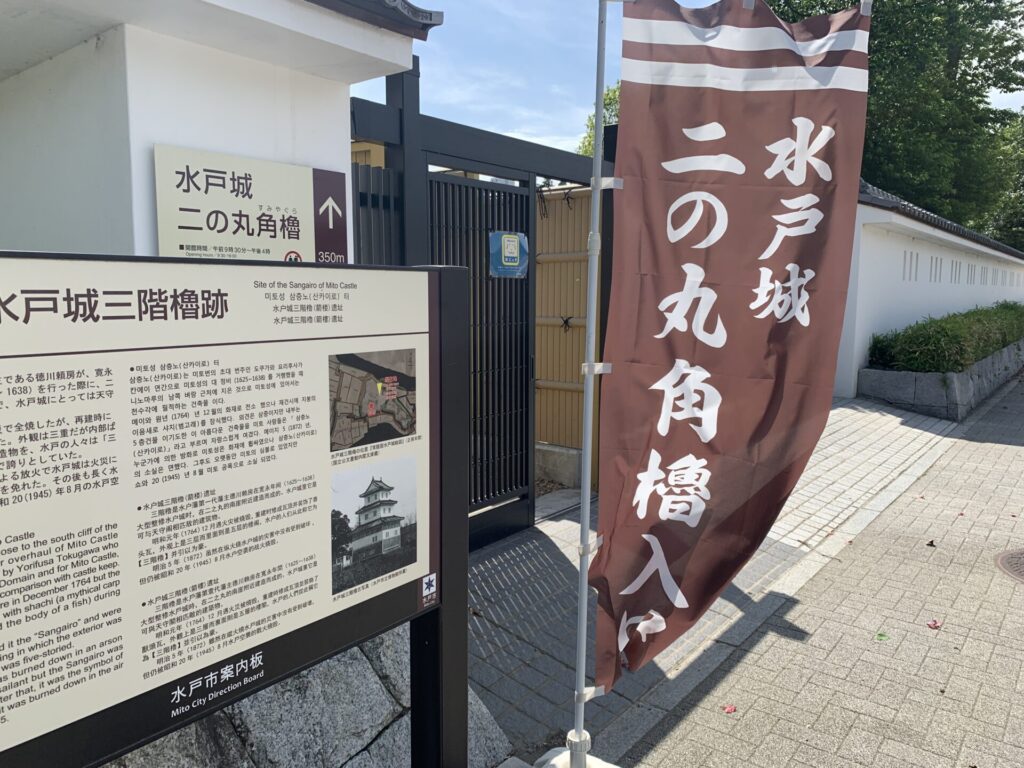
This is the entrance to the Ninomaru Sumiyagura(二の丸角櫓:Ninomaru Corner Turret ).
As noted on the information board to the left,
there was once a three-story turret here in the Edo period that could be considered the “tenshukaku” of Mito-jo,
but it was destroyed in an air raid during the war… what a shame.😔
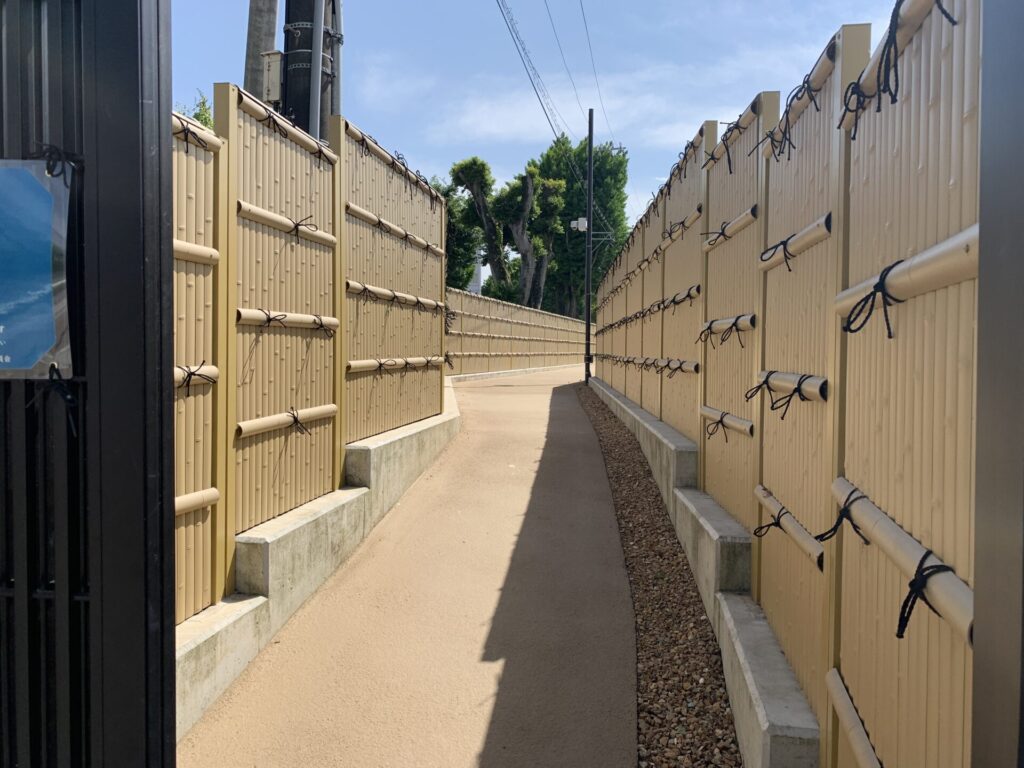
Upon entering, there is a narrow passage enclosed by bamboo fences on both sides.
It is just wide enough for two adults to barely pass each other.
This passage stretches on for quite a distance—perhaps around 200 meters in length…
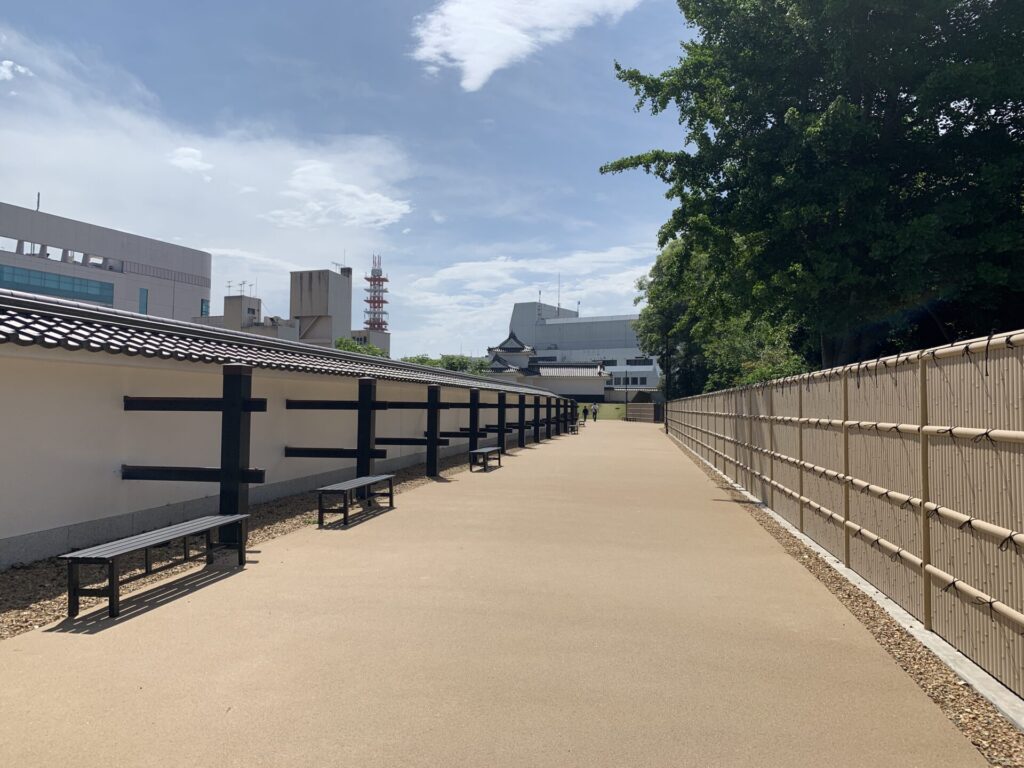
After walking for quite some time, the passage makes a sharp turn,
and then opens up into a wide space like this.
In the distance, I could finally see the Ninomaru Sumiyagura(二の丸角櫓:Ninomaru Corner Turret )!!
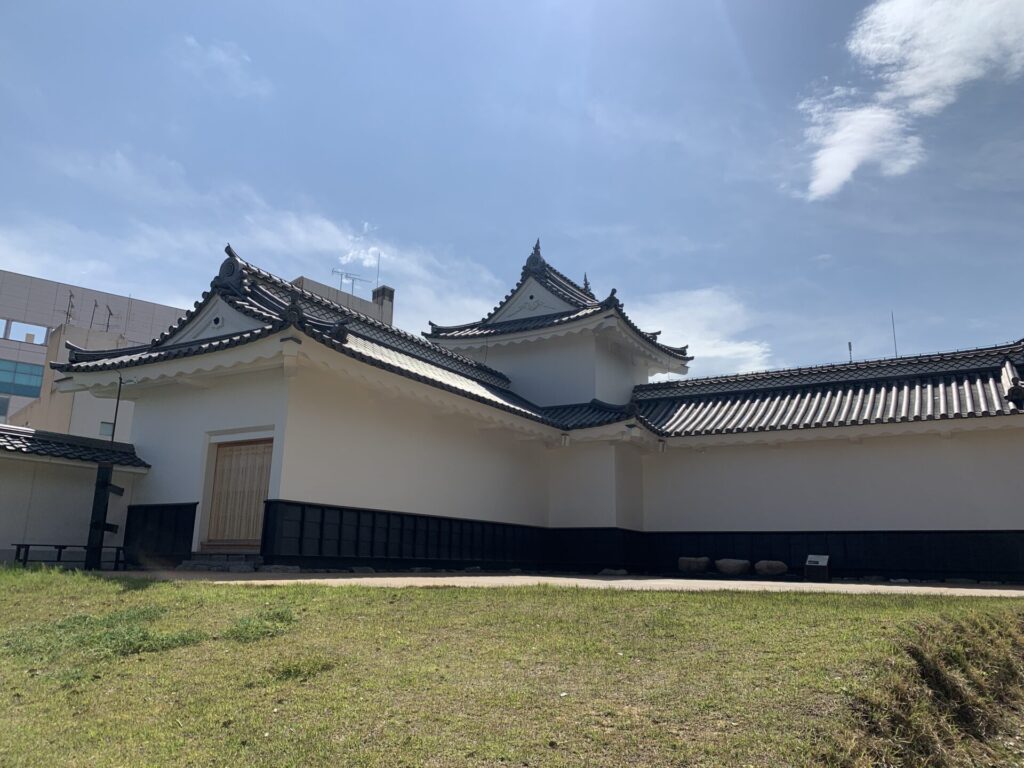
As you approach, it looks like this…
Because it was built at the corner of the castle grounds, it is also written as “Sumiyagura” (角櫓:corner turret).
During the Edo period, it was apparently clearly visible from the castle town, so it must have served as one of its symbols.
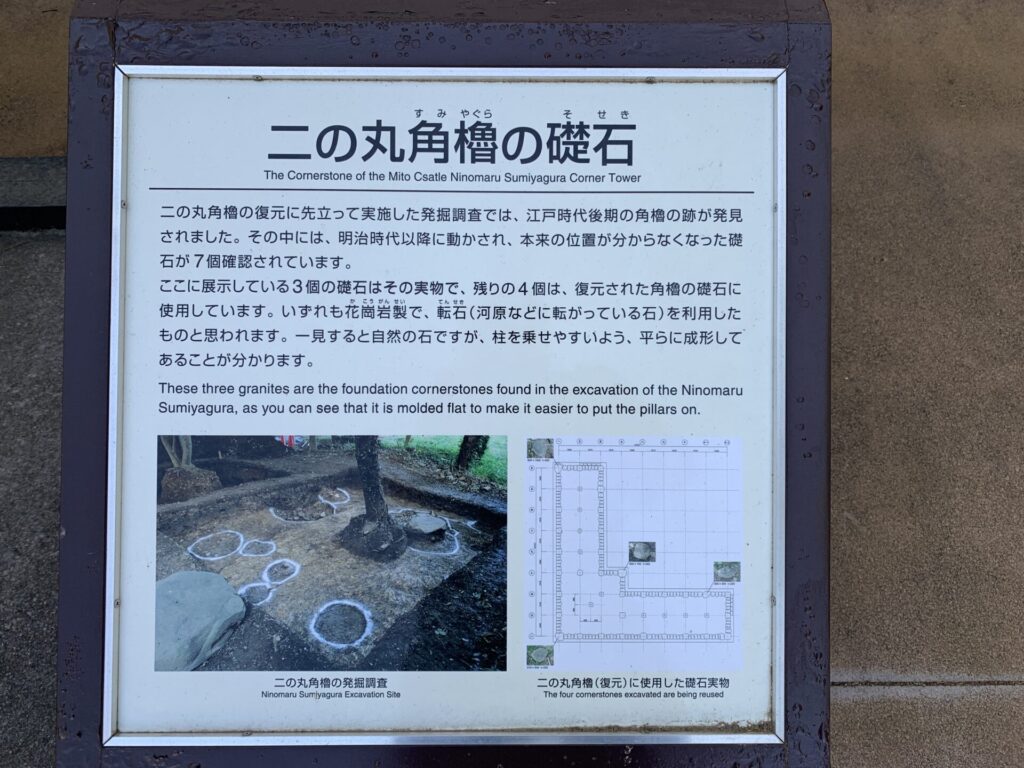
In front of the corner turret, actual foundation stones from that time were discovered, as shown here.
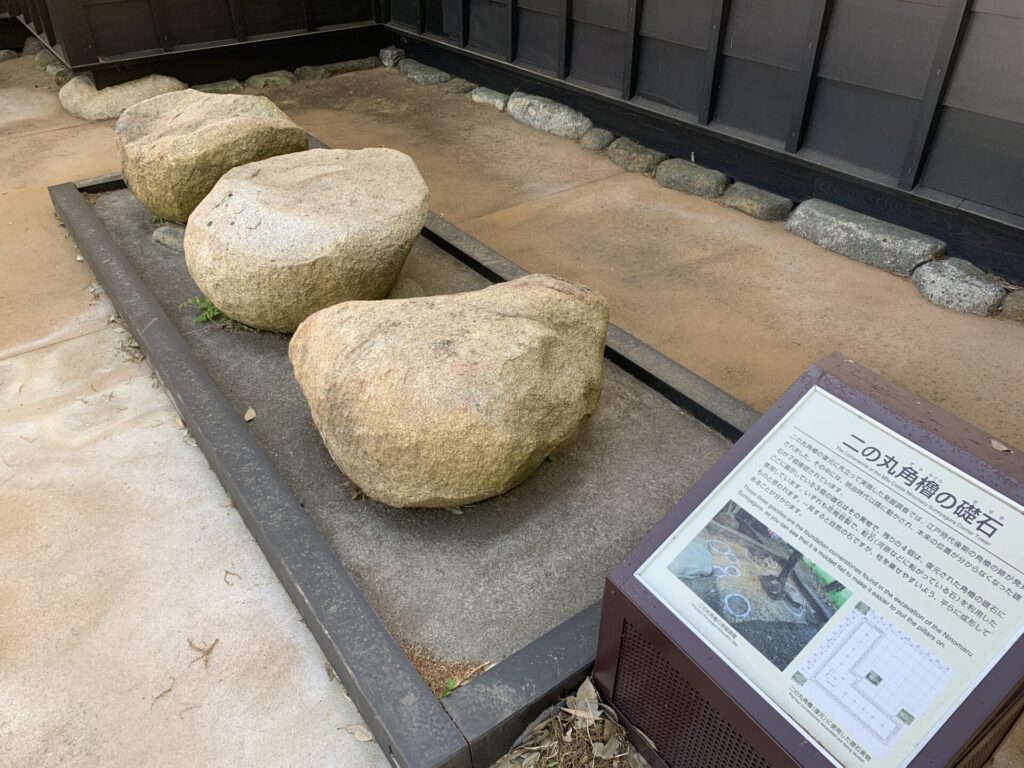
These are the foundation stones that were discovered.
I see—the tops have been flattened to make it easier to place the pillars.
Even though they are just stones, when you consider that they are surviving remains from that time, they feel extremely rare.
Now, as for this Ninomaru Sumiyagura(二の丸角櫓:Ninomaru Corner Turret ),
the interior has been turned into a small historical museum,
(which is often the case inside castle keeps or turrets).
You can view various historical materials here as well.
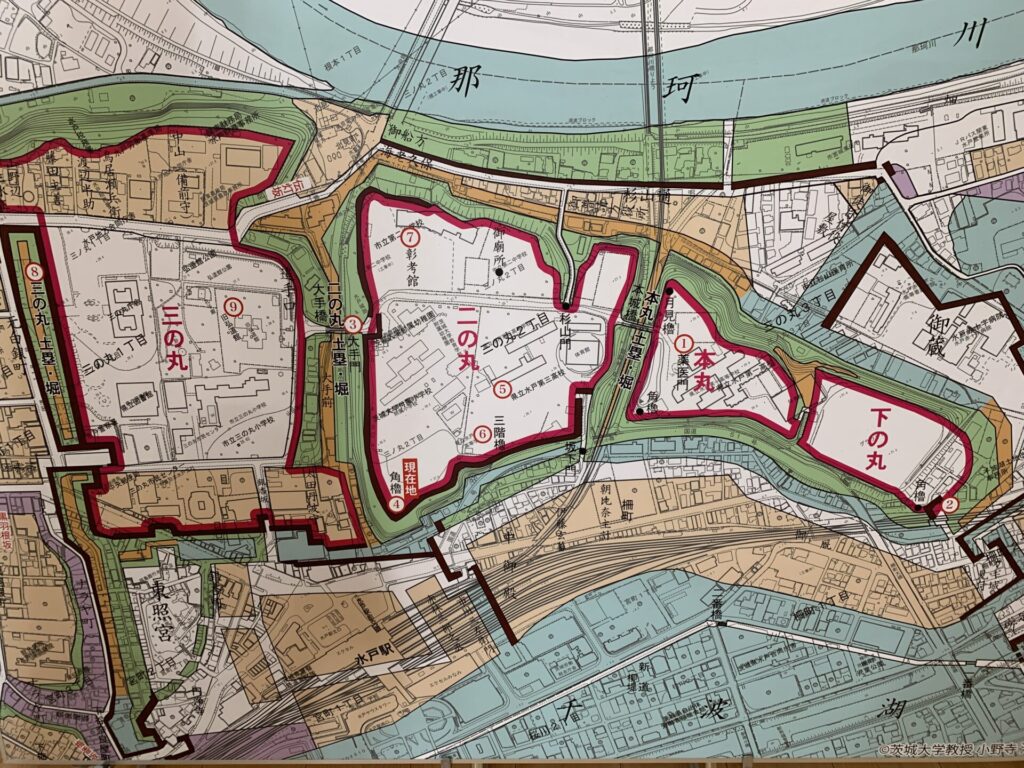
This castle layout map is one example.
It seems that Mito-jo originally consisted of only the Honmaru (①本丸 Main Enclosure),
but during the Sengoku period, when the Satake clan used it as their residence, and later in the Edo period under Tokugawa rule,
each gradually expanded the castle grounds over time.
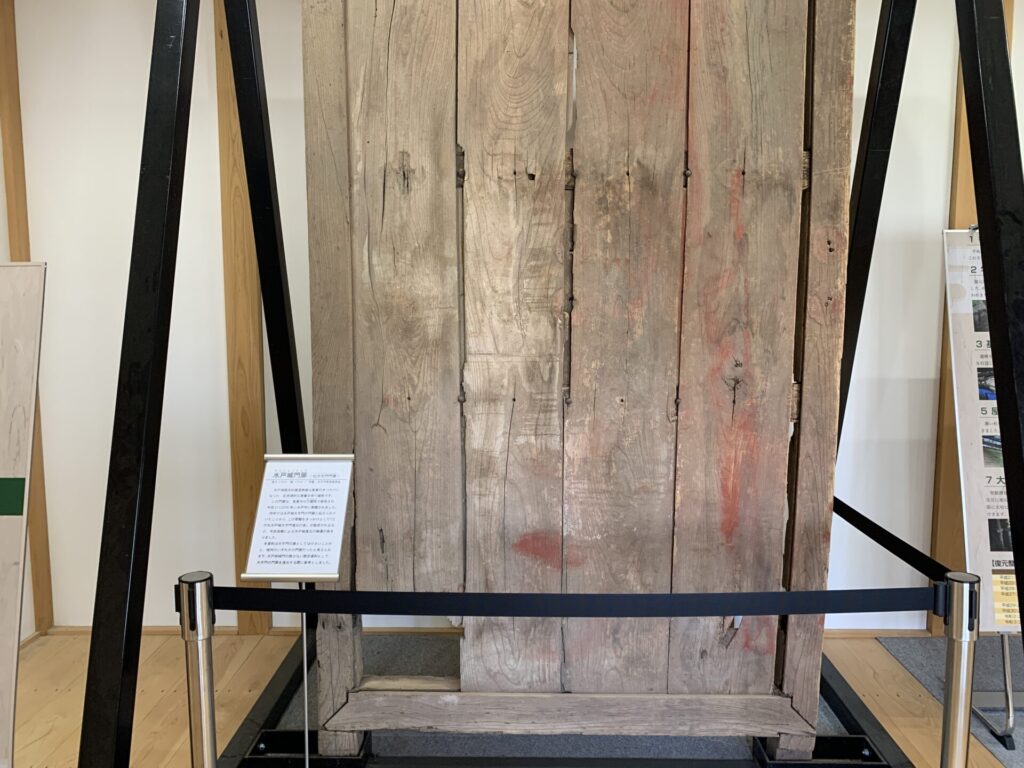
Inside, there is even what is said to be the original doors of Mito-jo’s Ōtemon Gate!
Since they are relatively small in scale, they may have actually belonged to another gate within the castle rather than the main Ōtemon…
Even from their appearance, there’s no doubt that they are quite old.
Now, on to the large dry moat of the Sannomaru!
The remains of Mito-jo continue on.
There is still one area I haven’t visited yet—yes, the Sannomaru (三の丸: Third Enclosure ).
The Sannomaru has a massive dry moat!
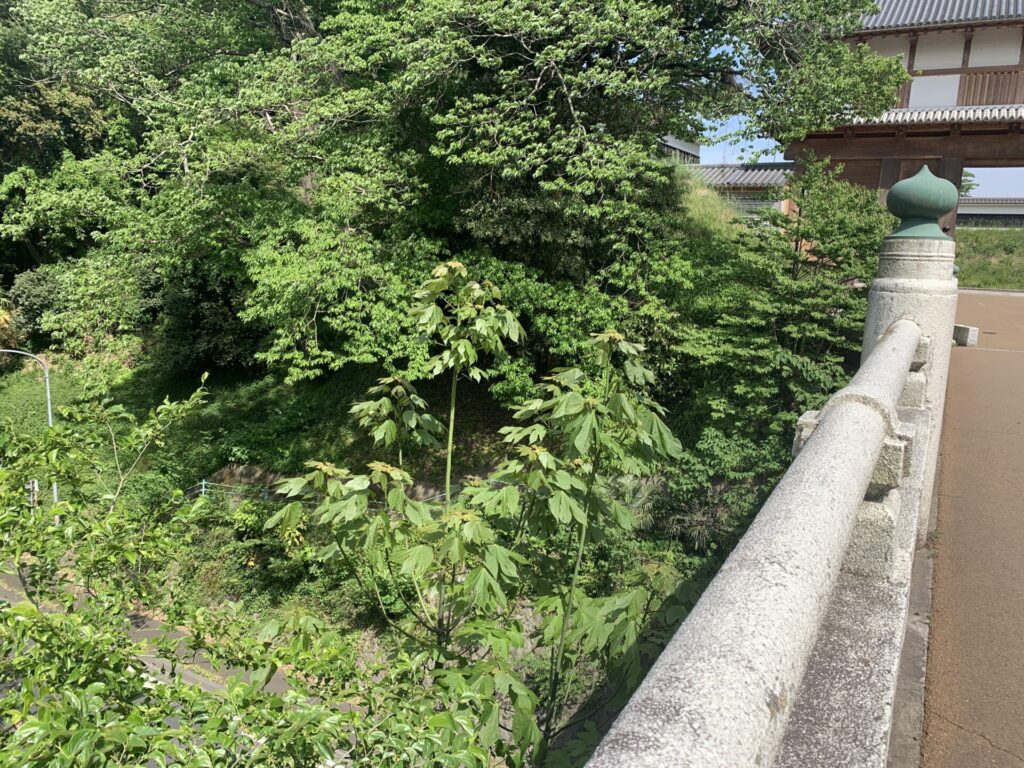
Leaving the Ninomaru behind,
I returned to the bridge at the Ōtemon Gate.
Naturally, there was once a large moat beneath this bridge connecting the Ninomaru and the Sannomaru.
Today, it has become a major road leading to Mito Station.
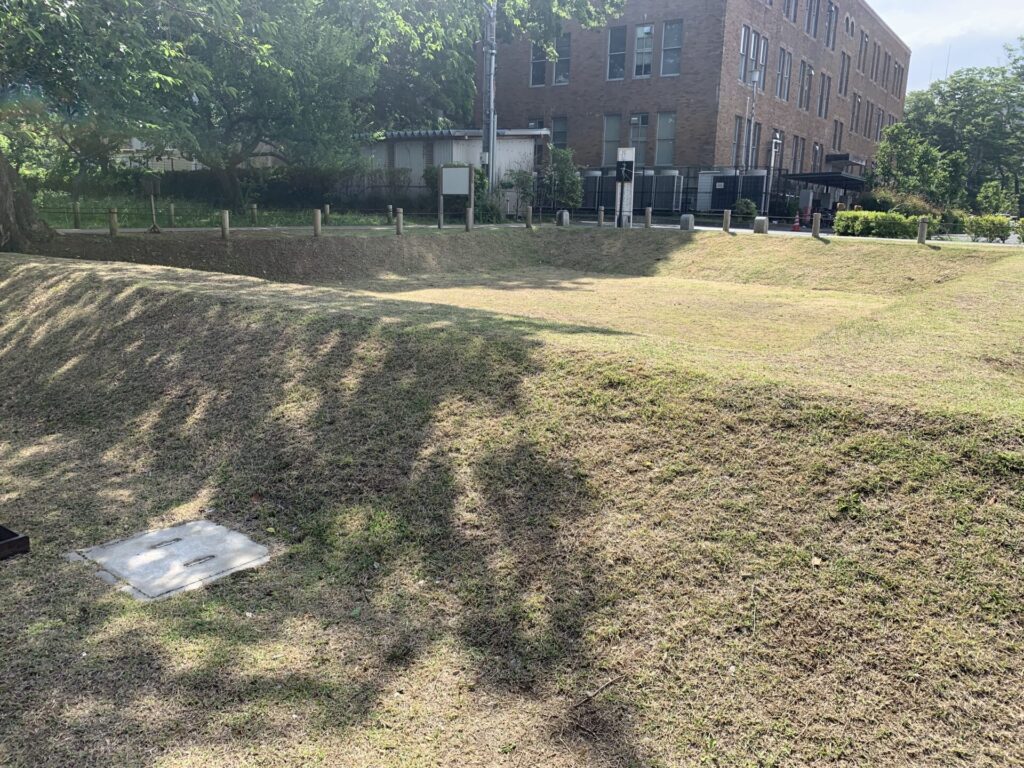
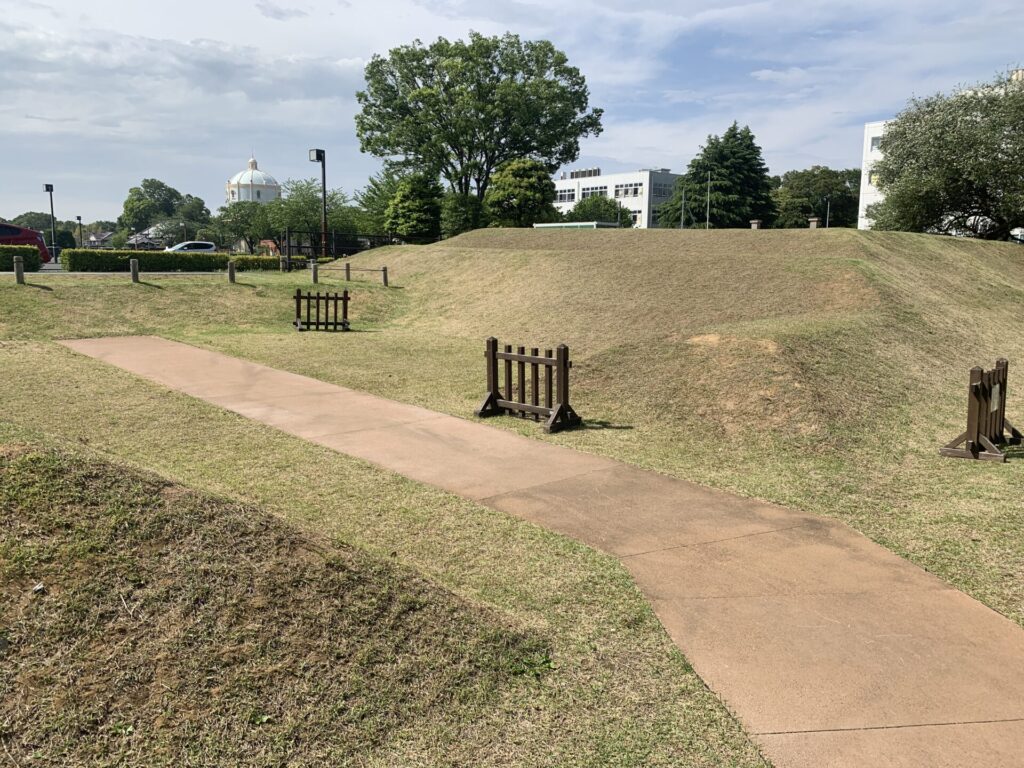
Passing by the Kōdōkan, I headed toward what is said to be a restored earthen rampart site.
After going through here, I made my way to the Sannomaru (三の丸: Third Enclosure ).
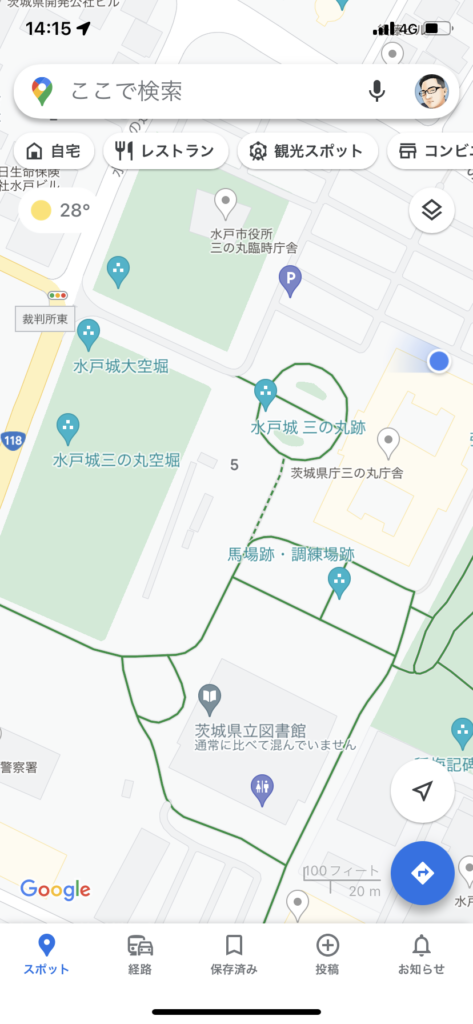
When checking on Google Maps, my current location looks like this…
Today, the former site of the Sannomaru is known by the rather impressive name of the Ibaraki Prefectural Sannomaru Government Office.
Ohkarabori (大空堀:The large dry moat) of the Sannomaru lies just ahead!!
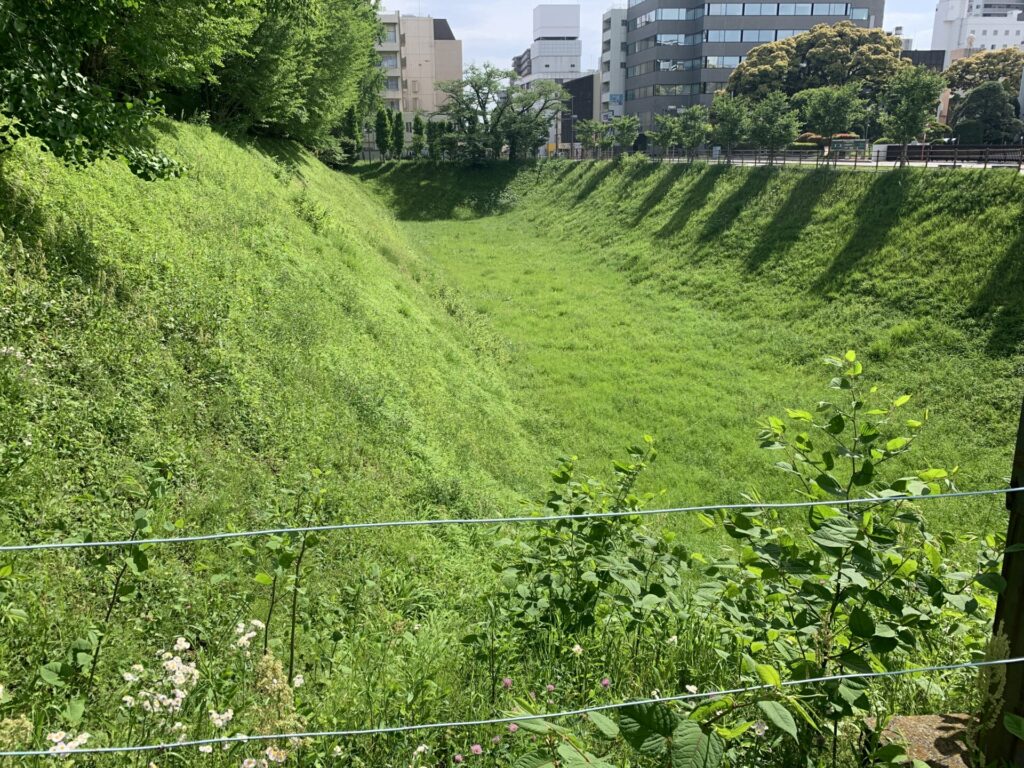
Passing through the Sannomaru Government Office, I arrived at the Ohkarabori (大空堀:The large dry moat)!!
Just like the JR Mito Line tracks connecting the Honmaru and Ninomaru,
and the road leading to Mito Station that connects the Ninomaru and Sannomaru,
this moat is equally deep and massive !! 😵
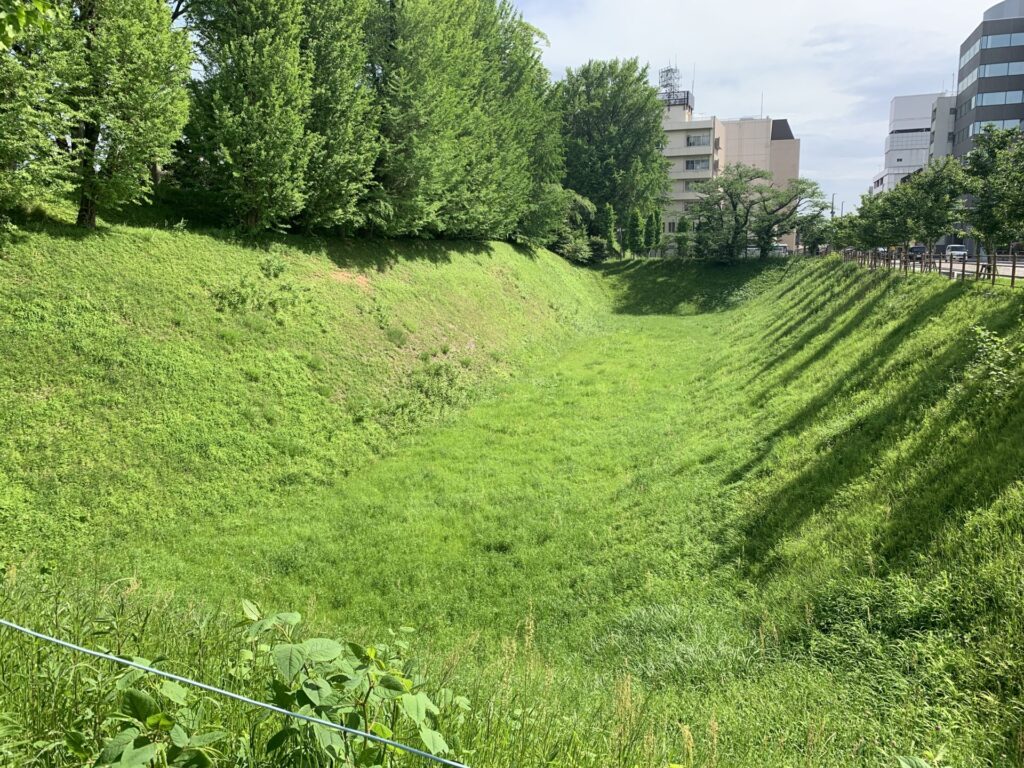
The green lawn shines brightly in the sunlight,
clearly revealing the shape of the dry moat.
Earthen castle dry moats are impressive in their own right,
but a moat like this, neatly maintained with grass, truly sparks a castle enthusiast’s curiosity.
This concludes my exploration of Mito-jo.
With its many cultural remains and its impressive defensive structures, it exceeded my expectations!
If you ever have the chance to visit Ibaraki Prefecture, be sure to stop by.
Until next time!!🖐️🏯